
Yong Tau Foo — My Father’s Recipe
We ate at a round table. It was the only piece of furniture my father, Sui Hing, was ever really proud of. He bought it with care, used it for the rest of his life, and it still sits in my brother’s house today.
That table is where I tasted his Yong Tau Foo, week after week, year after year. He never wrote the recipe down. He never had to. He cooked it the way a person who has cooked something a thousand times cooks it — by feel, by ratio, by the colour the garlic turned in the pan. When he passed, the dish went with him. Except, it turned out, it didn’t quite. He had cooked it in front of me enough times that I knew it from the inside. I make it now. I make it for my own family. I am, as far as I can tell, the only person who still does.
I’m not sure what dialect Yong Tau Foo properly belongs to. The stuffing — pork and fish paste, packed into vegetables — points to Hakka. But my father never used 大地魚, sole fish powder, which is the soul of a proper Hakka Yong Tau Foo. He didn’t have a hawker’s adherence to a tradition. He had his version. He’d taught himself.
He had a stall for a short while — 盛兴, Seng Heng, “prosperity and flourishing.” The queue was long enough that he needed help, and he couldn’t find any. We — my siblings and I — were all studying, doing what we were meant to do. The stall closed. The recipe came home with him, and it stayed in the family.
What I changed
Two things make my version different from his, and from most other versions you’ll find.
A French technique inside a Chinese dish. When you make a classical French mousseline — the very fine fish or chicken forcemeat used for quenelles and stuffed poultry — you beat cold cream into the puréed meat, gradually, over ice. The cream lightens the paste, emulsifies it, and gives the cooked stuffing a silken texture. I started adding a small amount of cream to my father’s pork-and-fish paste years ago, and the difference is the kind of thing that only matters if you care. The stuffing is finer. It holds together more reliably when fried. It’s slightly more buoyant in the mouth.
A clearer stock, less soup. My father made a whole pot. He’d fry the stuffed pieces, build a stock from scratch, and the dish lived in liquid — half braise, half soup. Mine sits closer to a French sauce: just enough liquid to coat and finish the vegetables, not enough to drink with a spoon. Neither of us has ever used the yellow soy-bean broth that hawker stalls in Singapore tend to default to. That was his choice. It became mine.
On the technique that matters most
The stuffing has to be stirred until it gets sticky and springy — the Chinese cooks I grew up around called this 起腼 (qǐ jiāo), meaning “rising glue.” In food science terms it’s myosin extraction: salt and stirring in a single direction develop the meat proteins until they bind and the paste turns elastic. The texture you want is what gives fish balls and meatballs their characteristic “QQ” bite. You will feel the moment the paste changes — it will pull cleanly away from the sides of the bowl and form ridges that hold their shape. Until that happens, keep stirring.
The cream then goes in slowly, in two or three additions, beaten through after each. The paste should stay smooth and pale, not split. If it starts to look broken, you’ve added too much too fast.
Notes on the vegetables
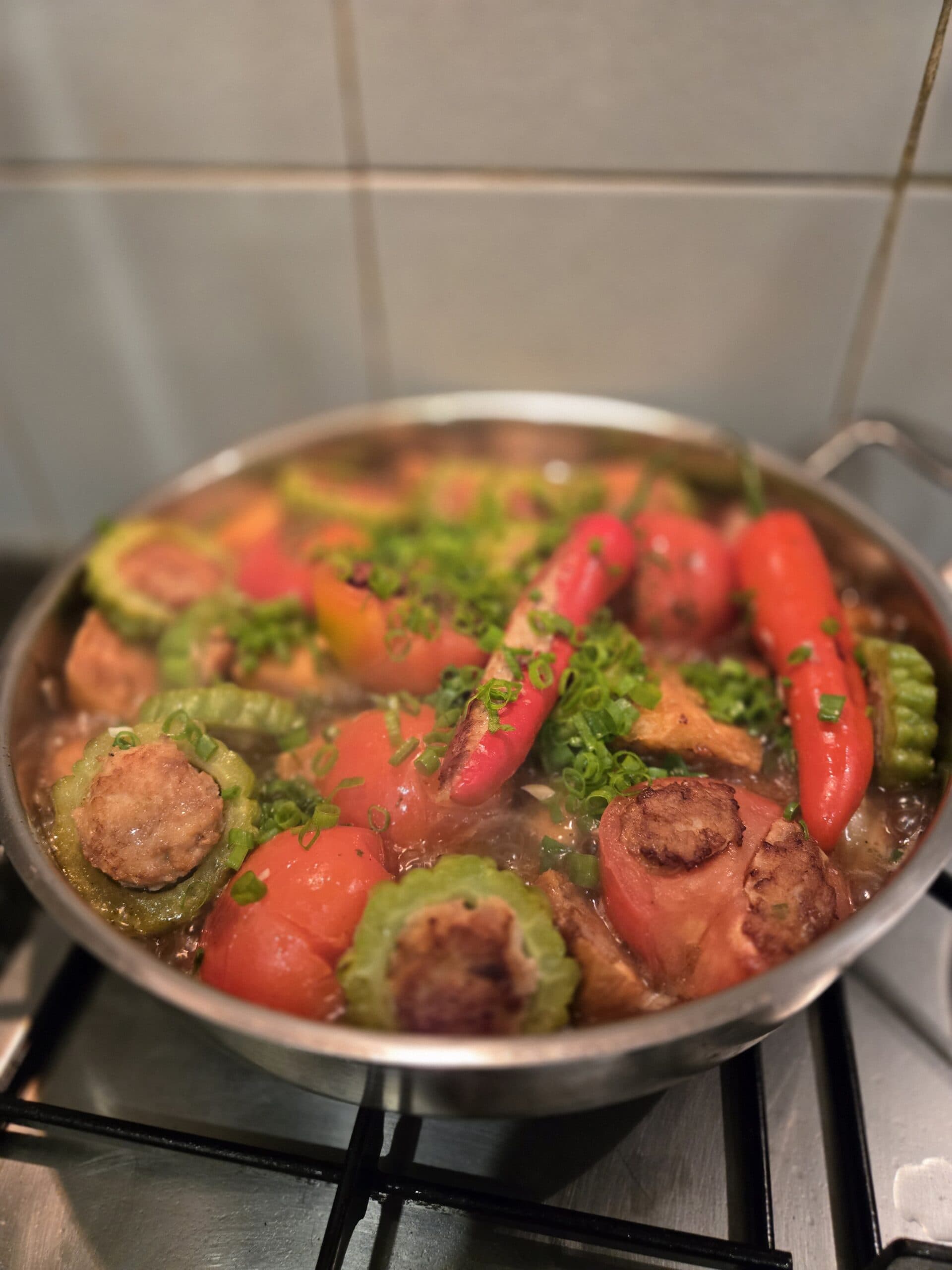
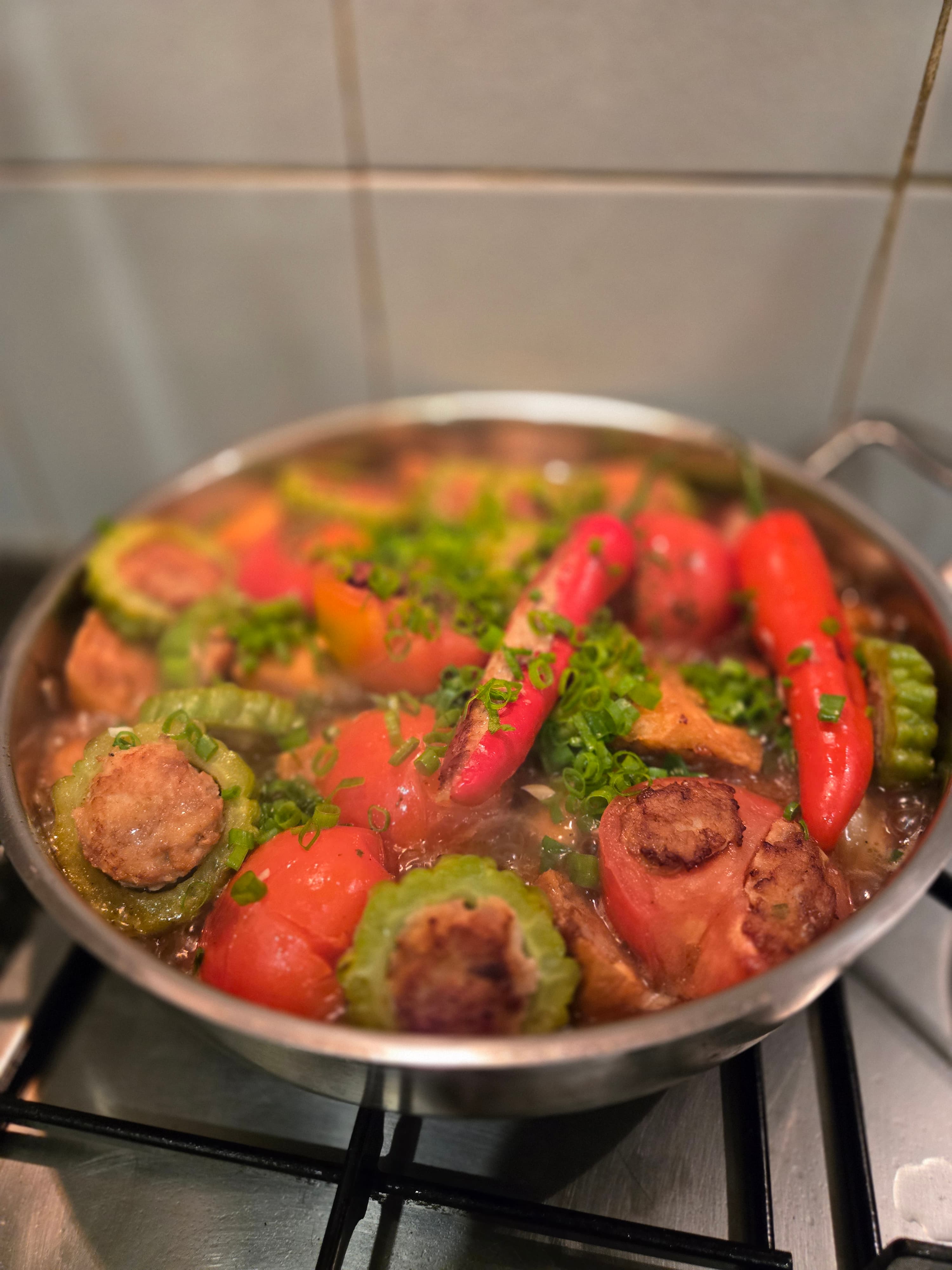
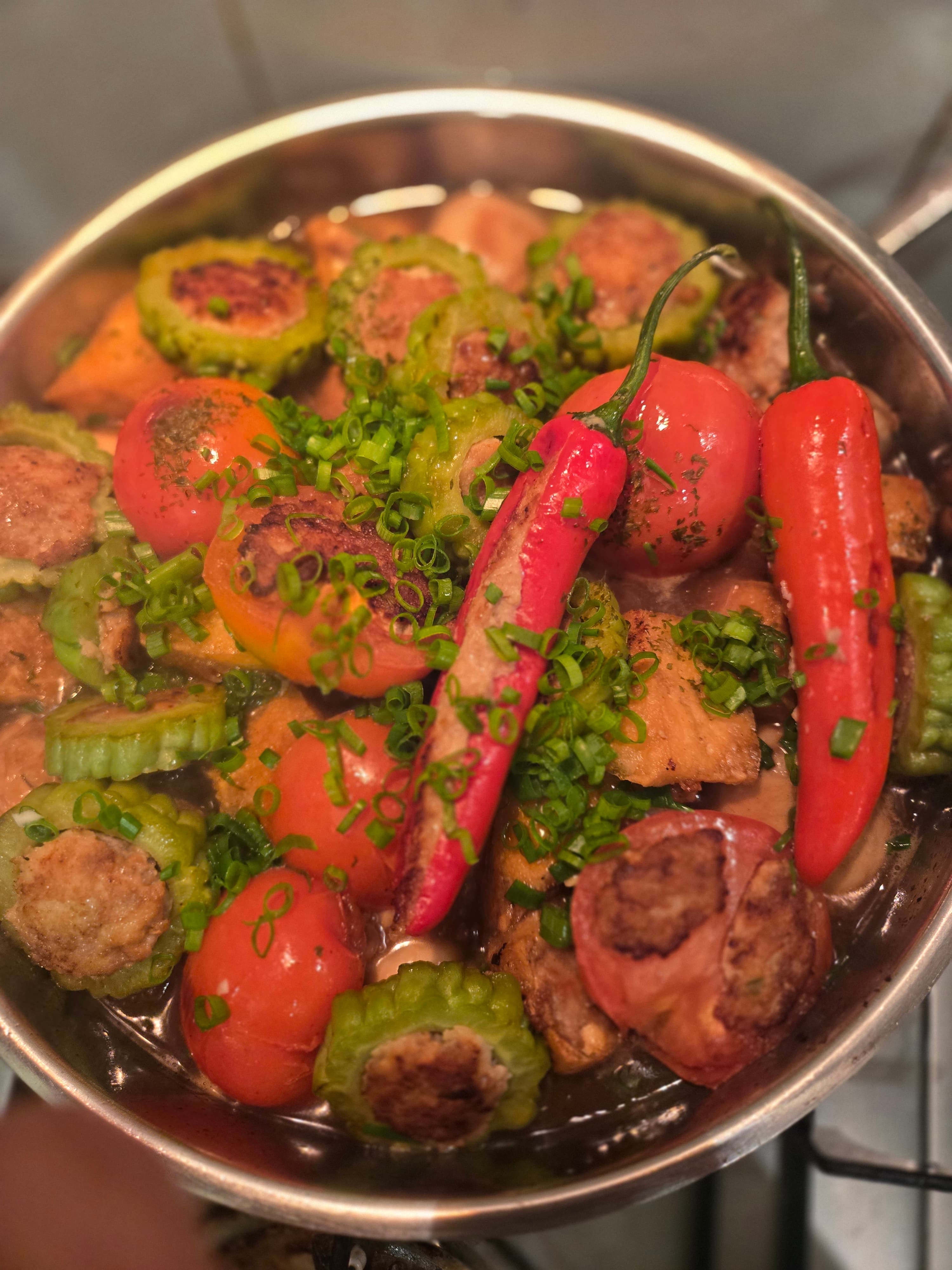
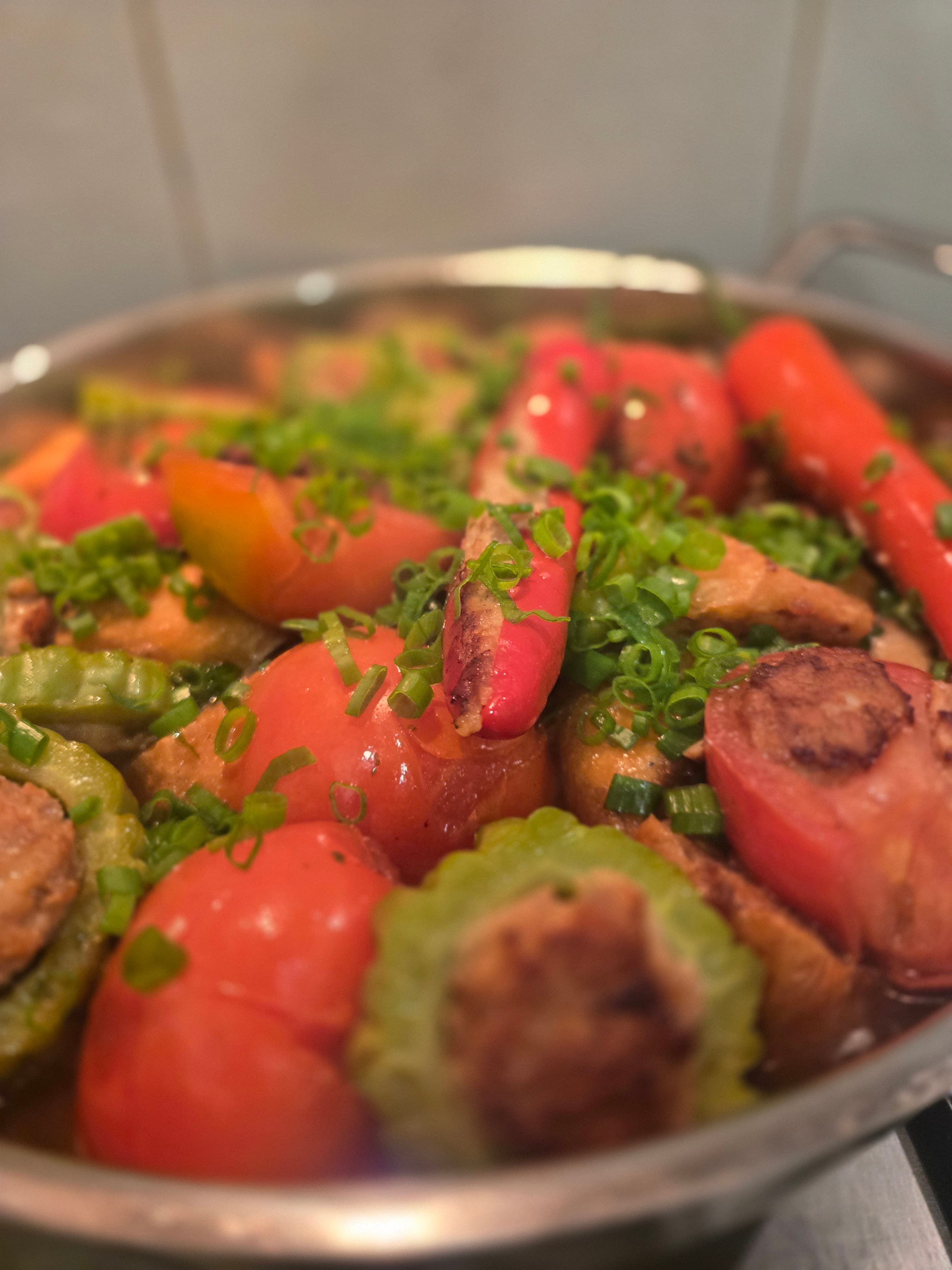
Use what you can find, but four of them are non-negotiable in this house: chillies, tofu, mushroom, bitter gourd. The chilli for heat and a contrasting bite of vegetable. The tofu because Yong Tau Foo without tofu isn’t really Yong Tau Foo. The mushroom because the umami it picks up from the stuffing is the best part of the dish. The bitter gourd because every version of this in our family had one, and the contrast between the bitterness and the rich stuffing is what makes the whole plate work.
Tomato, brinjal (eggplant), lady’s fingers (okra), and hard-boiled eggs are also welcome. Tomatoes are particularly good — halved across the equator, hollowed slightly, stuffed across the cut face. They collapse a little as they cook and pick up the stock beautifully.
A word on the stock
Don’t skip the Shaoxing wine (花雕酒, hua diao jiu). Drizzled onto hot oil and garlic just before you add the stock, it gives the dish a depth that nothing else does. If you don’t have it, a dry sherry works. The dark soy is for colour as much as flavour — go light or you’ll lose the look of the stuffing.
After dinner
I make this dish more often than is reasonable. It feeds six comfortably. It freezes well — the stuffed pieces can be pan-fried, cooled, and frozen flat, then dropped into hot stock from frozen. It is one of the most forgiving dishes I know, and one of the most personal.
If my father had written down the recipe, this would be that note. He didn’t, so this is mine, in his memory.
Yong Tau Foo — My Father's Recipe
A memoir-style Hakka-leaning Yong Tau Foo: stuffed vegetables with a pork-and-fish paste lightened French mousseline-style with cream, finished in a clean stock instead of the usual soy bean soup. Adapted from my father, Sui Hing, of the short-lived Seng Heng stall.
- Prep
- 45 min
- Cook
- 30 min
- Total
- 0 min
- Serves
- 6 servings
Ingredients
- 250 gfish paste (Spanish mackerel, yellowtail or threadfin)
- 250 gminced pork, not too lean, ~20% fat
- 60 mldouble cream, cold, add gradually, up to 80 ml by feel
- 1 tspchicken bouillon powder
- 0.5 tspwhite pepper
- 0.75 tspfine salt, adjust to taste
- 3large red chillies, slit and seeded
- 1block firm tofu (about 300 g), cut into 6–8 thick rectangles
- 6large fresh shiitake mushrooms, stems removed
- 1medium bitter gourd, sliced into 1 cm rings, seeded
- 2medium tomatoes, halved across the equator and hollowed slightly
- 1medium Asian eggplant, cut into 3 cm rounds, slit
- 6lady's fingers (okra), slit lengthwise
- 3hard-boiled eggs, halved
- 2 tbspneutral oil
- 3cloves garlic, minced
- 2 tbspShaoxing wine (花雕酒)
- 700 mlgood chicken or pork stock
- 1 tbsplight soy sauce
- 1 tspdark soy sauce, for colour
- 1 tspoyster sauce
- 0.5 tspchicken bouillon powder
- 1 tbspcornstarch slurry, 1 tbsp cornstarch + 2 tbsp water
- sliced spring onion, to garnish
Method
- Make the stuffing
- 01In a large bowl, combine the fish paste, minced pork, bouillon, white pepper and salt. Using clean hands or a sturdy spatula, stir in one direction with force — slapping the paste against the side of the bowl, then folding it back to the centre. Continue for 5 to 8 minutes. The paste will start to look glossy, pull cleanly away from the sides, and hold ridges when you draw a line through it. The Chinese term is 起胶 — 'rising glue'. This is the texture you want.
- 02Add the cream in two or three additions, beating each one through fully before adding the next. Start with 60 ml; add more only if the paste still feels tight. The final paste should be smooth and pale, not split or loose. Cover and chill for 20 minutes.
- Stuff the vegetables
- 03Score the cut surface of each vegetable piece very lightly with a knife — this helps the stuffing grip. For tofu, hollow the cut face slightly with a teaspoon. For mushrooms, the gill side faces the stuffing. For tomatoes, scoop out the seeds gently.
- 04With a butter knife or small spoon, mound stuffing onto each piece. Press to fill, leaving a slight dome on top. Don't underfill — the stuffing shrinks slightly when cooked.
- Pan-fry
- 05In a wide, shallow pan (about 10 cm deep), heat 1 tablespoon of oil over medium heat. Working in batches, place the stuffed pieces stuffing-side-down first and fry for 2 to 3 minutes, until the stuffing is golden brown. Flip and brown the vegetable side for a minute or two. The pieces should not be cooked through at this stage — just sealed and coloured. Remove and set aside.
- Build the stock and braise
- 06Wipe out the pan. Heat the remaining 1 tablespoon of oil over low heat. Add the minced garlic and cook gently for 30 seconds, until fragrant but not coloured. Drizzle in the Shaoxing wine — it will sizzle. Let it cook for 10 seconds.
- 07Pour in the stock and bring to a simmer. Add light soy, dark soy, oyster sauce, bouillon and pepper. Taste — it should be deeply savoury but not heavily salty.
- 08Return the stuffed pieces to the pan, stuffing-side up. Spoon stock over each one. Cover loosely and simmer gently for 10 to 12 minutes, until the vegetables are tender and the stuffing is cooked through. The bitter gourd should still have a slight bite; the eggplant should be silky.
- 09Stir the cornstarch slurry to recombine and drizzle it into the simmering stock around the pieces (not directly on top of the stuffing). Swirl the pan to distribute. Cook for 30 seconds more — the stock should thicken to a light, glossy coating, not a heavy gravy.
- 10Scatter sliced spring onion across the surface. Serve in a shallow bowl, with the stuffed pieces arranged so each diner can see what's on offer, and the stock spooned around. Eat with rice or thin egg noodles.
<p>A few things worth knowing: the cream is what makes the stuffing finer than a traditional Yong Tau Foo, but the amount is by feel — start with 60 ml and add only what the paste will absorb cleanly. The Shaoxing wine is non-negotiable; dry sherry works in a pinch but the dish loses something. The four vegetables I never skip are chilli, tofu, mushroom and bitter gourd. The stuffed pieces freeze well after pan-frying — cool flat, freeze on a tray, then bag. Drop them straight from frozen into hot stock and add 5 minutes to the simmer.</p>