
Portugese Egg Tarts (Pasteis de Nata)

While the Hongkongers make great egg tarts, across the sea, people who visit Macau would buy Portugese tarts. A close cousin to the Hong Kong egg tart. There are fans to both and they are both great.
I prefer the Portugese tarts because they look really rustic and cute. Egg tarts are deceptively hard to bake, no matter which ones we are referring to. The Hong Kong’s Flaky lining to the egg tart is notoriously difficult to make because of the fat-flour ratio, while the Portugese tart’s lining is simply the western puff pastry with a hint of cinnamon.
The custards of the two are also different. The Portugese tart’s custard has to boil and brown in spots, while the custard on the Hong Kong egg tart just sets without ‘boiling’. So the same recipe won’t work for both. I tried to do that and failed, so if your Portugese tart custard won’t boil or has no brown spots, it is because the recipe is not right. If the wrong recipe is used, the custard turns rubbery rather than burn with spots.
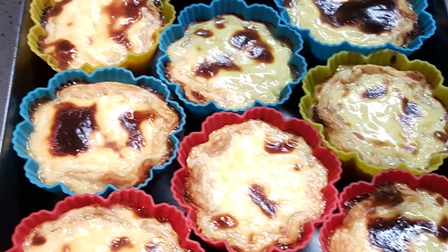
The temperature for the tarts must always be right, just like any custard.
Given the close resemblance in look and textures, I find it hard to think they are not of the same origin. The Portugese egg tart or Pasteis de Nata originates from Lisbon and is a copycat of the Pasteis de Belem. The latter being the original version of these egg tarts created by the Jerónimos Monastery in 1837 . The recipe was sold to a sugar refinery, Fábrica de Pastéis de Belém.
Since the name of the pastry, Pasteis de Belem, is trademarked, nobody can use that name. (how smart in handling their IPR!) It is not only trademarked, there is a close guard on the secret recipe and only three persons alive know its secret recipe and ingredients.
There are many copycats, and they can only use the name Pasteis de Nata. The recipe I share here is the closest to Pasteis de Belem I can derive from my research and observation about this sweet treat still baked by the descendants of this pastry company to this day. They will always enjoy long queues as locals and foreigners visit to get a sugar or curiosity fix.
Here’s how they make pasteis de belem… if you can figure it out!
Portugese Egg Tarts
- Prep
- 0 min
- Cook
- 0 min
- Total
- 0 min
- Serves
- 0
Ingredients
- 11/2 pieceFrozen Puff Pastry, thawed or make your own puff pastry
- 1 tspCinnamon Powder
- 1 tspRaw Sugar
- 250 mlMilk
- 100 mlCream
- Milk and cream can be replaced by 200ml of water and 6 tablespoon of milk powder - this tastes better
- 3Egg yolks
- 1 TbspCorn starch
- 1 tspVanilla essence
- 75 gSugar
- 1stick Cinnamon
- 1 sliceLemon Peel
- 1/2 tspSugar
- 1 gSalt
- 20 gButter
- 125 gCake flour
- 65 gWater
- 65 gButter for Laminating
Method
- Pastry
- 01Spread the cinnamon powder and sugar on the puff pastry. (Optional step)
- 02Roll it up like a swiss roll.
- 03Divide the rolled up puff pastry into 6 equal portions width-wise.
- 04With the cut edge facing up, use the palm to press each piece down, then roll the pastry into a circle.
- 05Line the egg tart tins (or muffin cups) with the pastry, ensuring it is slightly higher than the pastry tin.
- 06Using a fork, poke a few holes on the pastry lining and leave it in the freezer for 30 minutes or overnight.
- Custard
- 07<p>Put the egg yolks, milk, sugar, cinnamon stick and lemon peel in a saucepan over medium heat.</p>
- 08<p>Dissolve the sugar in the milk with a whisk over medium heat. Then add the corn starch.</p>
- 09<p>Sieve the custard mixture.</p>
- 10Pour the custard into the pastry cases, up to 70% full. If you try to do more, it might overflow and your tarts will be soggy. This is because the crust will contract first and then puff up and expand. If the custard overflows and dampen the pastry, it becomes soggy and will not cook.
- Bake
- 11Preheat oven at 210°C.
- 12<p>Put the tarts on the lowest shelf and bake for 20-25 minutes.</p>
- 13Sprinkle cinnamon powder on the tarts. (Optional step)
- Puff Pastry
- 14To make the puff pastry, combine all the ingredients except the laminating butter into a shining ball. Rest for 30 minutes.
- 15Wrap the laminating butter into the dough and do a book fold.
- 16Rest in the refrigerator for 15 minutes.
- 17Repeat the folding and resting for another 2 more times (a total of three times). Each time, the pastry must be rolled to about 0.7cm before folding.
- 18To use the pastry, roll it to 0.3cm thick.